Your CRM stopped being a database the day HubSpot's agents started reading it. Now it is context, and bad context is worse than no AI at all.

Your CRM stopped being a database the day HubSpot's agents started reading it. Now it is context, and bad context is worse than no AI at all.
The database framing undersold HubSpot, because the value was never only in storing records. For most of HubSpot's life, calling it a CRM was accurate enough. You stored contacts, tracked deals, ran email, and the value was mostly in not losing information. A spreadsheet with more structure.
AI changes what "value" means in that sentence. A language model can already do the model work: summarize a call, draft a follow-up, flag a deal that has gone quiet. What it cannot do on its own is know whether 30 days without movement is normal for your business or a five alarm fire. It does not know that your average sales cycle runs 90 days because you sell to procurement-heavy enterprises, or that a lead from a referral partner closes at three times the rate of a cold form fill. That is not a reasoning problem. It is a missing context problem, and no amount of model quality fixes it.
HubSpot now makes this argument on the record. Duncan Lennox, its CPTO, put it plainly in September: "Data is what happened. Context provides meaning around real events, what they mean, why they matter, and what to do about it" (Lennox). HubSpot calls the idea Growth Context, in five layers: business, customer, team, process and network.
Context is the operating history a generic AI tool never sees. Concretely:
Not "how long does a deal take," but how long a deal takes for this company, broken out by deal size, source and industry. That number only exists because deals have been logged, staged and closed consistently for months or years.
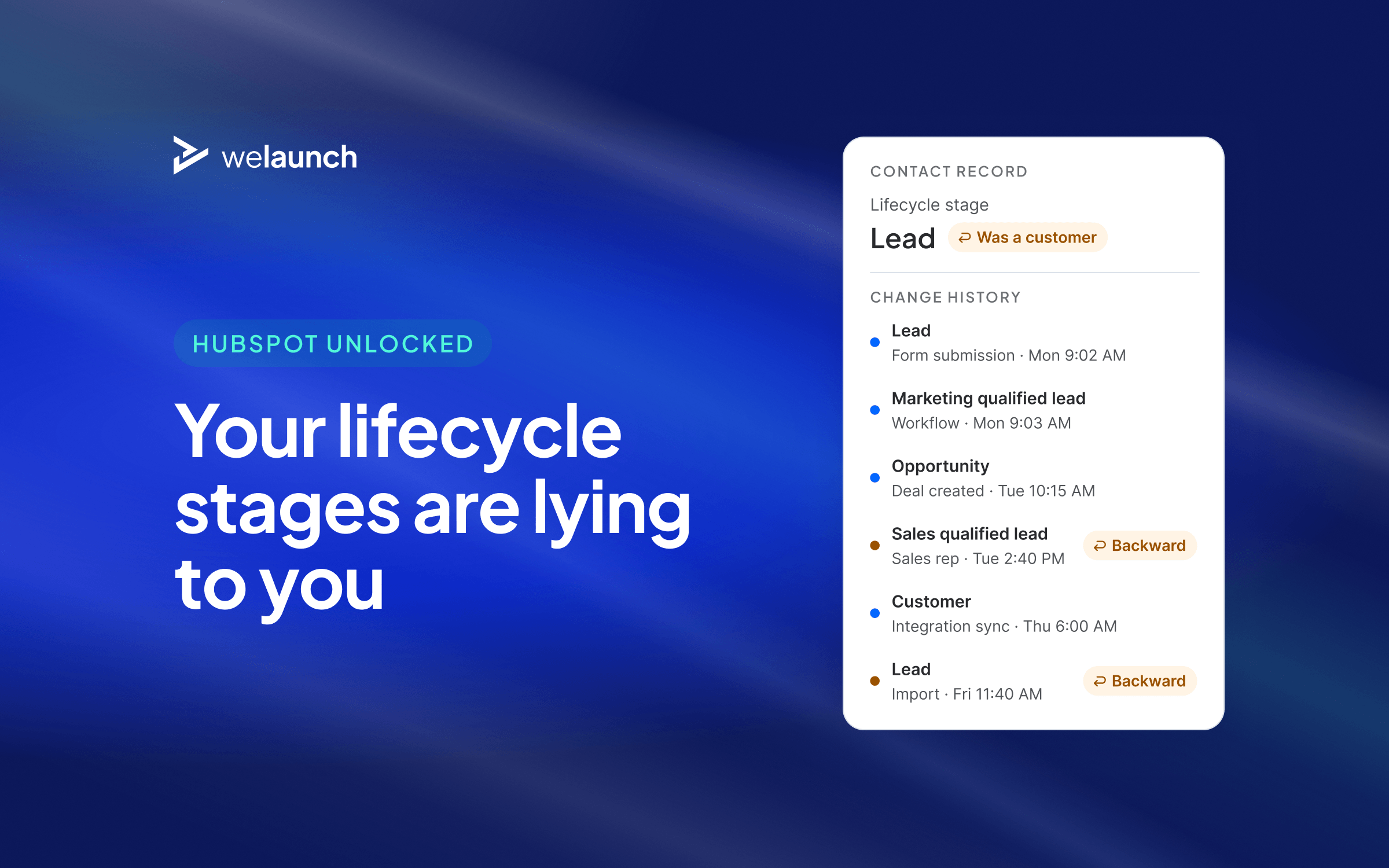
The path a contact actually took from subscriber to customer, including the stages they skipped, the ones they stalled in, and how long each took. This is the raw material for any agent trying to predict which leads are worth a rep's time today.
Which email opens, page visits and content downloads actually preceded a closed-won deal rather than a closed-lost one. The data is usually there. Whether it is structured well enough for an agent to use without a human translating first is a different question.
The things reps and CS write down in the moment: objections, competitor mentions, the specific reason a renewal almost did not happen. HubSpot's Fall 2026 release gave this context a home: Context Home holds what you tell HubSpot about your business, and the self-updating CRM captures what your calls, emails and meetings reveal (Context Home).
How the five layers map to a portal, and what we check in each:
| Layer | What it holds | Where it lives in HubSpot now | What we check in an audit |
|---|---|---|---|
| Business | Positioning, services, pricing, brand voice | Context Home, Business tab | The completeness score and gap list; whether the listed services match what you sell today |
| Customer | Account history, ICPs, personas | The CRM records, plus Context Home's Customers tab | Whether the written ICP matches who actually closed last year; whether contacts are associated to companies |
| Team | Sales methodology, qualifying criteria, escalation paths | Context Home, Teams and Processes tab | Whether MQL, SQL and each deal stage have a written entry criterion; whether records are owned by active users |
| Process | Workflows, handoffs, pipelines, campaign structure | Workflows, pipelines and campaigns, read at run time | Whether every active workflow has a stated purpose, and whether two automations write the same field |
| Network | What HubSpot has learned across its 280,000-plus customers | HubSpot's side | Nothing to fill in |
The Business row is where we have seen the quietest failure. In one portal serving two business lines, the AI context described only one of them. Nothing was wrong with what was written; half the business was simply missing. Anything generated from it would be on-brand for half the company.
It turns an implementation from a one-time install into ongoing context work. If HubSpot's real value is accumulated context, a lot of the way partners pitch HubSpot work stops making sense. A one-time build, get the pipelines configured, get the properties mapped, hand over the keys, treats HubSpot like infrastructure you install once. Context does not work like infrastructure. It compounds.
HubSpot's own numbers sharpen the point. CEO Yamini Rangan reported in September that AI on good context lifted MQLs and closed deals, while AI on bad context made both decline (The Outcomes Era is here). Those are HubSpot's figures, with no published methodology, but the direction is the finding: bad context is not neutral, it is a cost.
Here is what bad context looks like up close. In one portal we studied, a field that read like a permanent attribute was really a this-month flag, written by a sync that only touched recently active records. About one record in five carried last month's value forward, and the answer to one simple question had roughly a 30% spread depending on how you counted. The error only ever overstated. No error message, no blank field. A person might notice the number felt high. An agent reading that field would repeat it with confidence.
Two practical implications, whether or not you ever plug an agent into your CRM:
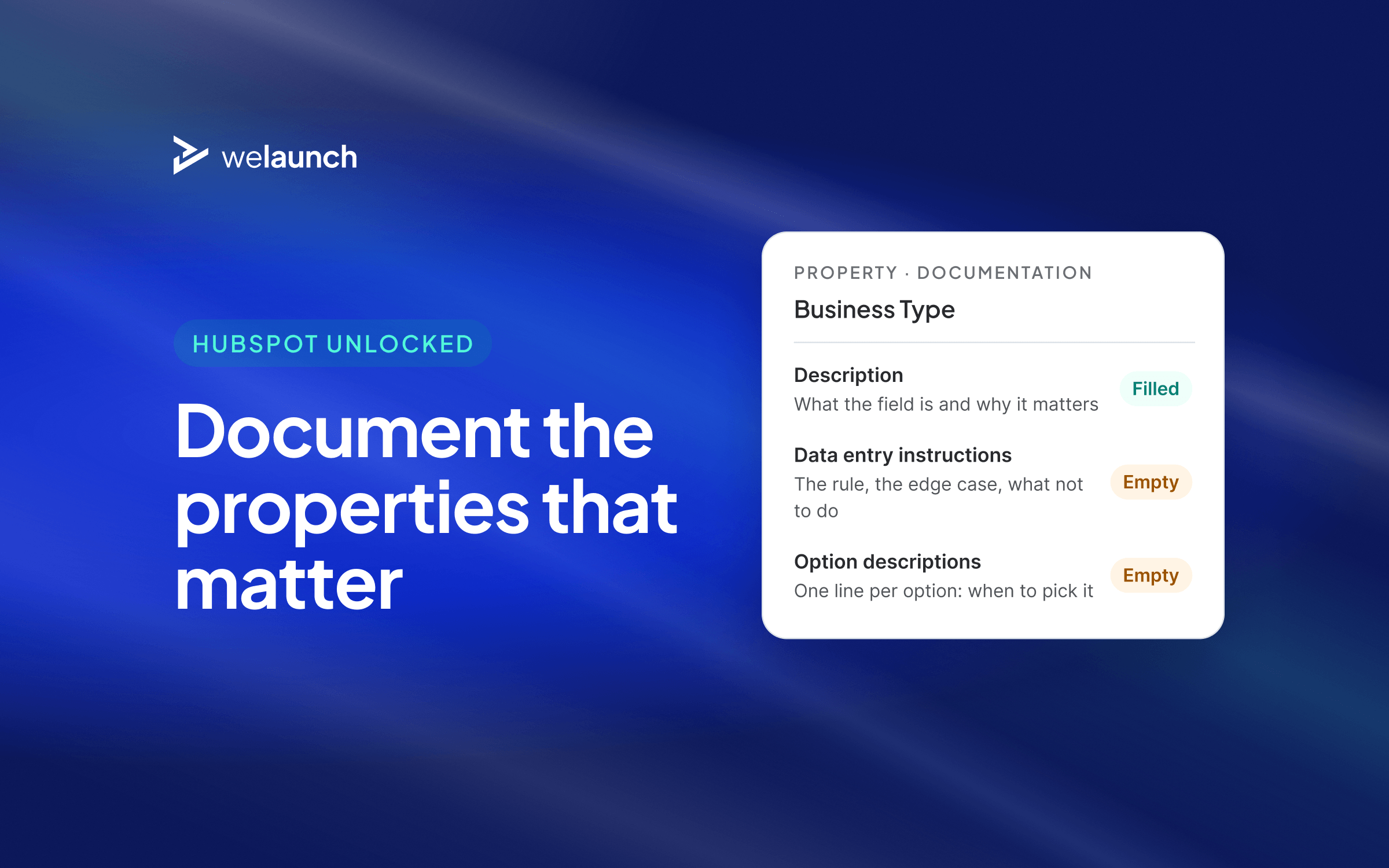
We do not point an AI agent at a portal we have not read first, and documentation comes before automation: a custom property without a description is a field nobody can interpret, including HubSpot's agents. It is an unglamorous rule, and it decides whether the AI layer on top is worth anything.
What we do before an agent is switched on, in this order:
Steps three to five are exactly what the this-month field above was missing. None of them needs new software; all of them need someone to read the portal first, which is why our engagements start with a diagnostic rather than a build.
This is not a claim that agents are already running your go-to-market motion, and it is not a claim that context alone wins deals. A perfectly documented portal at a company with a bad product or a confused ICP is still a portal full of context about a business that is not working. Context is leverage, not a substitute for the underlying strategy.
If you are deciding whether to keep investing in your CRM, the useful question is not what features the tool has today. It is how much of your operating history sits inside it, structured well enough for someone, or something, to reason over. That history is the asset. The software is where it lives.
If you are not sure how much usable context is in your portal versus how much is duplicate contacts and abandoned properties, that is what a HubSpot Portal Audit is built to surface. Worth doing before you plan the next twelve months of HubSpot work.