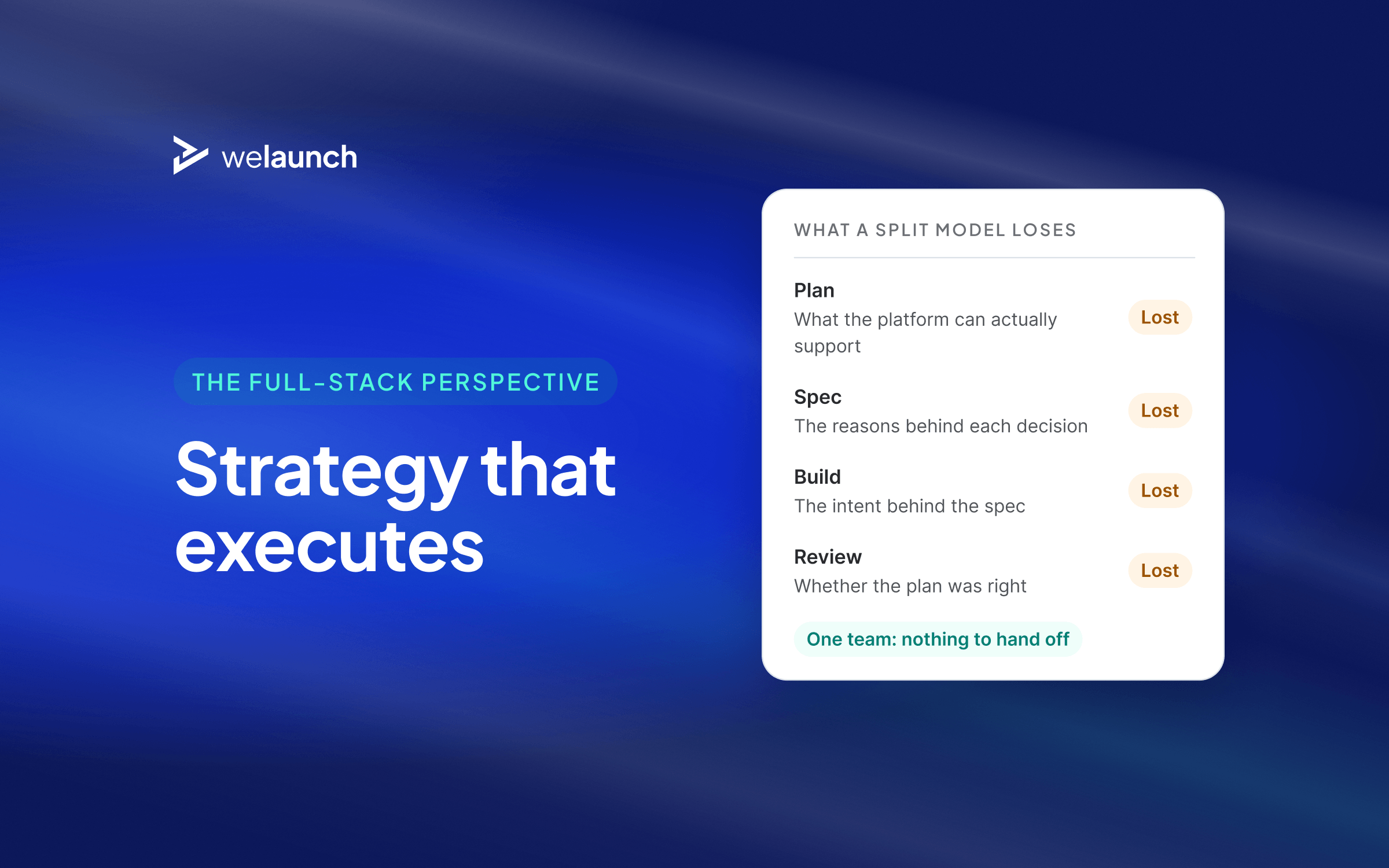
Agency, freelancer, fractional or in-house: you are not choosing a price. You are choosing which failure mode you can live with.

Updated
Agency, freelancer, fractional or in-house: you are not choosing a price. You are choosing which failure mode you can live with.
Updated
Each option buys something different: a freelancer buys hands, an agency a process, a fractional leader judgment, and an in-house hire permanent capacity.
| Freelancer | Agency or partner | Fractional leader | In-house hire | |
|---|---|---|---|---|
| What you are buying | Hands for a defined task | A team and a process | Judgment and direction | Permanent capacity |
| Typical monthly cost | Hourly, project sized | Typically low four figures to low five figures a month, depending on scope | Day rate or monthly retainer | Salary, benefits, tools, management |
| Ramp time | Days | Two to four weeks | Days for strategy, longer to execute | Six to twelve weeks, plus hiring time |
| Strategy included | Rarely | Varies wildly | Yes, that is the product | Depends entirely on seniority |
| Execution included | Yes | Usually | Rarely | Yes |
| What happens when they are unavailable | Work stops | Someone covers if the account is staffed for it, but may not know your portal | Work stops | Work stops |
| Institutional knowledge | Leaves with them | Leaves with the agency unless it is written into your system | Leaves with them | Stays only if documentation is part of the job |
| Best when | The task is well defined | Work is ongoing and varied | You know what to do is the gap | The work is permanent and full time |
| Worst when | The task is ambiguous | You need one narrow thing | You need someone to build it | Volume is lumpy |
The table hides the real decision, so here it is stated plainly: you are not choosing a price, you are choosing a failure mode. Every option breaks in a different way, and the right pick is the one whose failure mode you can absorb.
Best value per hour in the market, and the fastest to start. If you know exactly what you need built, a good freelancer will build it for less than anyone else, and you should stop reading and go hire one.
The failure mode is continuity. They get a bigger client, they go on vacation, they stop replying, and the work is frozen along with everything they knew about your setup that never got written down. That risk is fine on a discrete build. It is expensive on anything ongoing.
The second failure mode is scope. Freelancers are hired to execute a brief, so the quality of the outcome is capped by the quality of the brief. If your brief is wrong, you get a well-built version of the wrong thing.
You are buying a process and a bench. The good ones bring patterns from other companies, which is genuinely valuable when your problem is not novel, and most operations problems are not novel.
The failure modes are worth naming honestly: rigid scopes, cookie-cutter playbooks, and layered teams, where the person who sold you is not the person doing the work and the strategist never touches the system.
The last one is the one to test for. Ask who will actually be in your portal, and whether that person was in the room when the strategy was decided.
The bench has a catch of its own: when your usual person is out or moves on, whoever covers may never have seen your portal. Ask who covers, and how they get up to speed.
A fractional CMO or revenue leader buys you senior judgment at a fraction of a senior salary, and for a company that genuinely does not know what to do next, that is the highest-leverage spend available.
The failure mode is the handoff. Fractional leadership produces a plan, and a plan needs hands. If you hire direction without hands, you get an excellent roadmap and a quarter of no movement, then a second hire to execute it, at which point you are paying for two things that could have been one.
This is the specific trade-off we were built to remove, so treat that paragraph as an interested opinion. It is still true.
If the work is permanent, predictable and full time, hire someone. Nothing beats a person whose entire job is your business, and the economics stop favoring outside help once the volume is genuinely constant.
Two failure modes at this size. First, lumpiness: operations work below $5M arrives in bursts, so a full-time hire is oversubscribed during a migration and underused in the quiet months. Second, knowledge gaps: a single hire is one person's skill set, and strategy, marketing ops, sales ops, reporting, integrations and design are not one person's skill set. What we usually see is a capable generalist who is excellent at four of the six things you needed and quietly stuck on the other two.
And when they leave, everything they knew leaves with them unless somebody made documentation a condition of the job.
Whoever you hire, ask this: after you leave, who owns the definition of a qualified lead and the entry criterion for each deal stage?
If the answer is "it is written down in your system and your team agreed to it," the engagement was worth it regardless of the staffing model. If the answer is "it was in their head," you rented an outcome rather than building one, and you will be having this conversation again next year.
Handovers leave a residue you can measure. In two portals we audited this year, the contrast was plain: in one, about two thirds of the dashboards were owned by someone who no longer had access; in the other, none were. In the first, a shared agency login also held super admin, so nothing done through it could be traced to a person. Neither is a staffing-model problem. Both are what a departure looks like when nobody planned for one, and the second is worth asking any agency or freelancer about before you sign.
What we would do instead, whichever model you choose: every login belongs to one named person, nobody outside your company holds super admin by default, and when anyone leaves, everything they own in HubSpot, dashboards included, is reassigned and they are taken out of any workflow that names them, before their access is removed. That order is HubSpot's own advice for deactivating a user.
That is the test we hold ourselves to. Our working sessions are deliberately structured so the client's team does the work in HubSpot while we watch and correct, rather than us doing it while they watch. The output is meant to be fluency, not dependency.
We are the wrong pick in four specific cases.
There is a fifth, softer one. If you are already past about $10M with a real team and permanent volume, you are usually in hire-in-house territory, and an outside partner is best used for the specialist project your team cannot staff.
Each buys something different: a freelancer buys hands, an agency a process, a fractional leader judgment, and an in-house hire permanent capacity. You are really choosing a failure mode rather than a price, so pick the one whose failure mode you can absorb.
When the work is permanent, predictable and full time. Below about $5M in revenue, operations work tends to arrive in bursts and spans more skills than one generalist usually covers, so a single hire is often oversubscribed during a migration and underused in quiet months.
The handoff. Fractional leadership produces a plan, and without hands to build it you get an excellent roadmap, a quarter of no movement, and then a second hire to execute it.
Every login should belong to one named person, and nobody outside your company should hold super admin by default. When someone leaves, reassign everything they own in HubSpot, dashboards included, and take them out of any workflow that names them before their access is removed. The definition of a qualified lead and each deal stage's entry criterion should be written down in your system, not kept in someone's head.
The fastest way to narrow this is to look at what you actually have rather than debate what you need. A HubSpot Portal Audit produces a prioritized picture of your setup that is yours to keep, and it is a useful brief whether you end up hiring a freelancer, an agency or nobody at all. If you would rather just talk it through first, get in touch.